
Legibility has had a bad rep among technologists for over a decade now. The idea comes from James C. Scott's Seeing Like a State, where Scott, an anarchist anthropologist who spent his career studying Southeast Asian peasant cultures, documented what happens when states impose simplifying schemas on complex systems. The book became Silicon Valley canon after Venkatesh Rao's review of it. In it he gives the classic example of modern legible forestry:
"The early modern state, Germany in this case, was only interested in maximizing tax revenues from forestry. This meant that the acreage, yield and market value of a forest had to be measured, and only these obviously relevant variables were comprehended by the statist mental model. Traditional wild and unruly forests were literally illegible to the state surveyor's eyes, and this gave birth to "scientific" forestry: the gradual transformation of forests with a rich diversity of species growing wildly and randomly into orderly stands of the highest-yielding varieties. The resulting catastrophes – better recognized these days as the problems of monoculture – were inevitable."
The state as we know it applies this same logic to several other schemes such as standardized surnames, planned cities, and land titles. In every case the state's need to see clearly and with order destroyed a layer of local, practical knowledge that the system had actually been running on, and in the worst cases the schemes failed catastrophically. This type of misguided rational paternalism (often born of a genuine desire to improve things) can be identified across a myriad types of power structures and millennia.
Ever since it became canon, this idea of legibility has gotten a bad rap. Particularly in our tech community, it has been viewed as something undesirable for entrepreneurs attempting to do interesting things. Illegibility, "becoming ungovernable," founder mode, choosing exit over voice: these are all variations on the same theme of carving out a space the state cannot see into, on the theory that anything the state can see, it will eventually degrade. And it’s important to note that the state doesn’t only literally mean the government – existing power structures like large companies, investment arms, etc. all represent this risk.
But now that everyone, begrudgingly or not so begrudgingly, admits that technology is one of the strongest shapers of modern life (that is, it has become legible whether you like it or not), perhaps it is worth writing a little ode to legibility and what it has done for technology. Let’s look at 3 informative examples throughout the last century: radio, personal airplanes, and cryptography.
Squint a little and you find that the history of technology, and of the protocols underlying it, can be defined by strategic legibility negotiated with the state. One way to tell this story would be through entrepreneurs, but entrepreneurship is tied up with the state and with legibility in complex ways. Entrepreneurs favor legibility when it suits them and oppose it when it does not. So instead, I want to tell this story through amateur technologists and experimenters, the technically minded who are early to a technology and have a missionary zeal for its future.
Amateurs in the airwaves
Early radio was pioneered by amateurs who scavenged parts from public telephones and built self-authored identities around the technology. In the 1900s, radio pioneer and inventor Marconi wanted institutions such as the military and newspapers to use the radio as a replacement for the telegraph and telephone. Marconi and his promoters imagined a future in which institutions had dedicated channels for communication but this did not come to pass. The military viewed it as lacking enough privacy (you could be overheard by other operators) and companies viewed it as inefficient. Even though institutions were wary, the underlying technology of the radio kept improving. The invention of crystal receivers had made building radios cheaper and this was seized upon by amateur experimenters, who were the biggest adopters of radio for several years.
By the mid 1910s, though, the airwaves had become so noisy as to be nearly unusable, with broadcasters, amateurs, and the military all transmitting over one another. Eventually the government stepped in and split the spectrum into bands, which made the medium stable, brought investment, and led to standardization and the broadcast revolution.
The amateurs did almost get evicted in the process, a pattern that would be familiar to the story we’ve been telling about state destruction via the push for legibility. But, they fought for and won a licensed amateur service with its own protected slices of spectrum, and that carve-out is what kept amateur radio alive through the century.
Critically, this turned out to be a good deal for everyone, not just “charity” for the amateurs. The amateur bands became a proving ground where operators could experiment cheaply at frequencies the industry had dismissed as worthless, and the hams promptly demonstrated that short waves could cross oceans, a discovery the commercial and military world then built upon. The amateur license also functioned as a talent pipeline, a legible category through which generations of engineers entered electronics. The state got an orderly spectrum, the industry got a stable foundation for investment, and the amateurs got a durable, legally protected place to play. Nobody had to become ungovernable.
Amateur radio had some staying power even as late as the beginning of the internet era. In 1981, almost a century after the spectrum split, an amateur radio operator named Hank Magnuski requested a block of IP addresses and got assigned 16.7 million of them, which he then assigned to radio operators (his friends) across the world. The informal group of operators who managed these addresses formed Amateur Radio Digital Communications, a foundation which sold a block of these addresses to Amazon in 2019 for $130M.
Amateur radio is a clear case where legibility not only didn’t come at the expense of the organic communities that it sought to govern, but instead improved their lives by adding the right amount of order to a system that needed it. The state may not have known these positive externalities for amateurs would come from ordering the spectrum (intent matters) but the case is informative for the role that legibility can play for adoption and cultivation of new technology.
Amateurs in the air
J.G. Ballard's 1979 novel The Unlimited Dream Company begins with a schizoid young man stealing a Cessna light aircraft and crashing it into the Thames. He climbs out of the plane, swims to the bank, and discovers he is in Shepperton, a suburb of London, which he proceeds to transform into the site of a pagan carnival, mesmerizing every animal and human in town like some kind of primeval god. The setup of the novel is that we never learn whether these events are real or whether they are the dream of a tragic, untrained pilot as his plane explodes into a ball of fire.
To the modern eye the idea of an untrained solo pilot invokes images of hobbyist joyriders (everyone has that one friend who is trying to get their pilot license). Today air travel means commercial air travel, conjuring up the usual unpleasant cocktail of budget mass air transportation experiences. Indeed, by the time Ballard wrote his novel, the light-aircraft market was itself only a few years from collapsing under product liability lawsuits and saturation.
But about thirty years before that, in the 1940s, the personal aircraft market really did resemble what would seem like a schizoid phenomenon to most of us in 2026. For several years there was genuine competition between cars and planes as the mass mode of personal transport (!). Fred Weick had published his now widely cited paper on the everyman's airplane in 1936, by which time several companies were already attempting to build personal aircraft. And after the second world war, this fantasy briefly looked like an industry. Peak personal aircraft arrived in 1946. GIs returning from the war were given extensive subsidies for flight training, factories were producing thousands of light planes a month, and ERCO, the company where Weick served as chief engineer, was selling its Ercoupe at J.C. Penney and other department stores as an everyday aircraft, a plane you could buy the way you bought a car.
The market, of course, eventually corrected. The United States was transforming from a war economy to a consumer economy, the demand for personal planes turned out to be far lower than their supply, and by the late 1940s sales had collapsed to a fraction of their peak. What remained from this carnivalesque era of experimentation was a smaller group of pilots, often military veterans, who were interested in building and flying planes recreationally.
In 1952, the CAA, the precursor to the FAA, created the experimental amateur-built standard, which granted recreational pilots building their own planes far more lax regulation than certified aircraft. To qualify, the builder had to have done the major portion of the fabrication and assembly, a threshold that came to be known as the 51 percent rule. This energized the pilots. Soon after, in 1953, Paul Poberezny, a veteran of the Second World War and Korea, started the Experimental Aircraft Association from the basement of his home outside Milwaukee, with the goal of meeting and executing test flights with other amateur builders. The EAA has since stewarded the preservation and expansion of the experimental aircraft category for seven decades, defending it each time the rules threatened to tighten, most visibly in the late 2000s when the FAA proposed stricter fabrication quotas in response to modern quickbuild kits and the builders fought the proposal back down.
In July 2025, Sean Duffy, the current United States Secretary of Transportation, stood on a stage in Oshkosh, Wisconsin, and told a crowd of pilots, builders, and assorted aviation obsessives that he was about to unleash American ingenuity. The occasion was the announcement of MOSAIC, the Modernization of Special Airworthiness Certification, a regulation more than two decades in the making, which, among other things, threw out the weight limit that had boxed in amateur light-aircraft manufacturing for a generation.
Why is this important for our story? Because MOSAIC unlocks a runway for an entirely new kind of aircraft. By redefining the light-sport category (light sport aircrafts are built to industry consensus standards than FAAs full type-certification process) in terms of performance rather than weight, the rule cracked open a side door through which electric vertical takeoff and landing craft, or eVTOLs as they are popularly called, could enter the recreational world rather than waiting out the decade-long ordeal of full type certification. The flying car, that perennial punchline of unfulfilled futurism, now had a real regulatory pathway. Companies such as AIR, which had spent years flying prototypes under experimental permits, could now begin to imagine selling them to ordinary people.

Of course, several things needed to go right in addition to just the regulatory loophole.Mass manufacturing eVTOLs is now conceivable because the cost of lithium-ion batteries has fallen while their density has risen (something Packy wrote about in his excellent Electric Slide), and because the cost of building an electric motor has fallen alongside it, both trends subsidized by industries that had nothing to do with aviation: first smartphones, then drones.
But it is easy to imagine a counterfactual in which none of this component-level progress mattered. Without the experimental aircraft category – a clear artifact of a legibility endeavor – and the sport-pilot rules that grew out of it, all stewarded and defended by the EAA for seventy years, there would have been no existing legible slot for a two-seat electric aircraft to occupy. Every eVTOL, no matter how small, would be facing the same multi-year, nine-figure type certification gauntlet that the air-taxi companies face today, and the personal eVTOL would have remained a prototype category indefinitely. MOSAIC did not have to invent a regulatory frame from scratch. It stretched one that amateurs had kept alive, and kept legitimate, since 1952. That is what seven decades of strategic legibility buys you: when a new technology arrives, there is already a door for it, and a constituency the regulator trusts standing at the door.
Critically, as with radio, the state creating legibility that actually worked was borne of a dialogue and partnership with the amateurs that it seeked to govern.
Strategic Legibility and the Internet
Now, this type of strategic legibility never quite worked out for the internet. Radio and experimental aircraft both had a physical substrate the government could regulate, spectrum in one case and actual planes in the other. The internet's substrate is information, and the state's attempts to striate and make it legible have been much clumsier. Nothing perhaps illustrates this more than the fight over broad access to public key cryptography from the 1970s to 90s.
Up until 1975, no one outside the government in the United States performed serious work in cryptography. In their 1976 paper New Directions in Cryptography, Martin Hellman and Whitfield Diffie introduced the public-key model and a practical method now called Diffie–Hellman key exchange. With Diffie–Hellman, two parties publicly exchange mathematical values and independently calculate the same shared secret, while an observer who sees the entire exchange cannot feasibly reconstruct that secret.
This was a shot in the arm for cryptographers and cypherpunks working on cryptography because until then, cryptography had remained within the control of the United States government and a few contractors it worked with. Later in 1977, MIT scientists Rivest, Shamir and Adleman created RSA, which offered encryption stronger than the Data Encryption Standard (DES), a United States government approved encryption standard developed by IBM that did not use public keys. At the same time, the NSA was beginning a slow war of attrition with the cypherpunks. In 1979, the NSA sent a letter warning attendees of a cryptography conference that their attendance might put them on the wrong side of the law because cryptography, as it turns out, was export classified alongside munitions, sitting on the same regulatory list as fighter jets and cruise missiles. A story we have seen before: hobbyists and amateurs were advancing the frontier faster than the state could achieve legibility for it.
Through the 80s, the work of public key cryptographers started gaining traction because of the introduction of personal computers, something that the NSA finally had to reckon with. But still, at this point in the late 80s, cryptography was controlled by the NSA and a few private companies that had developed encryption solutions. This changed when Phil Zimmermann, a political activist, created Pretty Good Privacy, or PGP as it came to be known. PGP was an encryption software that implemented RSA along with a home brewed scrambler that Zimmermann called Bass-o-matic after an SNL sketch about a blender that liquefies fish (these are very serious men). Zimmermann gave the software away for free because he was paranoid that the government was going to outlaw privacy. He almost lost his house in the process, unable to make his mortgage payments.
It won’t surprise you to hear that in the early 1990s, Phil Zimmermann spent three years under federal criminal investigation because someone had uploaded his program to the internet, an act the government chose to treat as the illegal export of a munition. So in 1995, while the investigation was still open, MIT Press printed the entire source code of PGP as a hardback book, more than nine hundred pages of it, typeset in an OCR-friendly font with instructions for scanning it back into a computer. Export controls on books were hard to implement because it would be a clear and obvious infringement of free speech rights. The book shipped to European bookstores, volunteers abroad scanned it page by page, and the munition was thereby exported, legally by mail.
The government understood the repercussions of attempting to prosecute export on a book. The investigation was dropped in early 1996, and the export rules were gutted within a few years. The regime of export controls and state legibility on encryption had withered away under 30 years of cypherpunks chipping away at the edges.
You eventually got the carnival explosion again through Bitcoin and Ethereum, a genuinely illegible monetary system built directly on the cryptography the state had failed to contain. And then that too got legibilized: exchanges acquired licenses, ETFs got approved, and the ungovernable currency ended up with ticker symbols and bureaucratic compliance departments.
On the physical substrate side, the United States did control several of the fiber and financial chokepoints of the internet in the 2000s. The internet felt placeless and decentralized, but nevertheless all the actual traffic ran through a small number of buildings, and one of them was at 611 Folsom Street in San Francisco. In 2002, a veteran AT&T technician named Mark Klein was working in that building when he noticed something odd: a new room had been built on the sixth floor, room 641A, and ordinary technicians were not allowed inside it. Only one field engineer had the key, and what qualified him was a security clearance from the National Security Agency.
Klein later got hold of the wiring documents and understood what he had been looking at. On the floor above, splitters had been installed on the fiber-optic lines carrying internet backbone traffic, small prisms of glass that bent a copy of the light, containing emails, searches and phone calls and everyone else's traffic that happened to be transiting AT&T's network, down into the secret room, where equipment built for mass inspection of internet traffic was waiting to read it.
As Henry Farrell and Abraham Newman argue in Underground Empire, the same was true of money, where dollar clearing and the SWIFT messaging system gave Washington a ledger of the world's transactions and a switch it could throw to cut any bank or country out of the global economy. For a while this was the most valuable kind of legibility, which the United States used surgically. But the U.S. eventually began to lose its grip precisely by overusing it, "using a scalpel like a bludgeon," as Farrell puts it. Every disclosed cable tap and weaponized sanction made both targets and allies wary of choke points that the United States controlled.
Coercive legibility, it turns out, spends itself down. Unlike the radio settlement or the 51 percent rule, there was no bargain underneath it that gave the governed a reason to stay. There was no dialogue with the governed community. So now we have different countries and blocs attempting to build their own payments infrastructure and their own strategic choke points that can be used as leverage.
Portals Not Enclosures
If legibility doesn't need to destroy but can instead help build, what does this kind of strategic legibility look like today?
Based on what transpired with radio, civil aviation, cryptography and the internet, we can draw a contour of the different regimes of legibility. Two things seem to matter most.
The first is whether legibility can be negotiated. To negotiate, you need a group of experimenters or amateur technologists who have made themselves legible to the state, usually by organizing around legislation for their field. The radio amateurs did this by pushing for amateur licensing. The aircraft homebuilders played a big role in getting experimental aircraft licenses passed. On the other hand, cryptography in the 1970s had experimenters who were ignored in preference of the federal government’s export controls. The regulation there was unilateral, and stayed that way until the cypherpunks broke it from outside. This is the negotiable versus non-negotiable axis.
The second is how the boundary of the category gets drawn. The 51 percent rule is measured. You either did the major portion of the fabrication or you did not. Cryptography was declared part of the Munition List with no clarity on how technologists could get involved or what advances are required for the tech to be available outside the government.
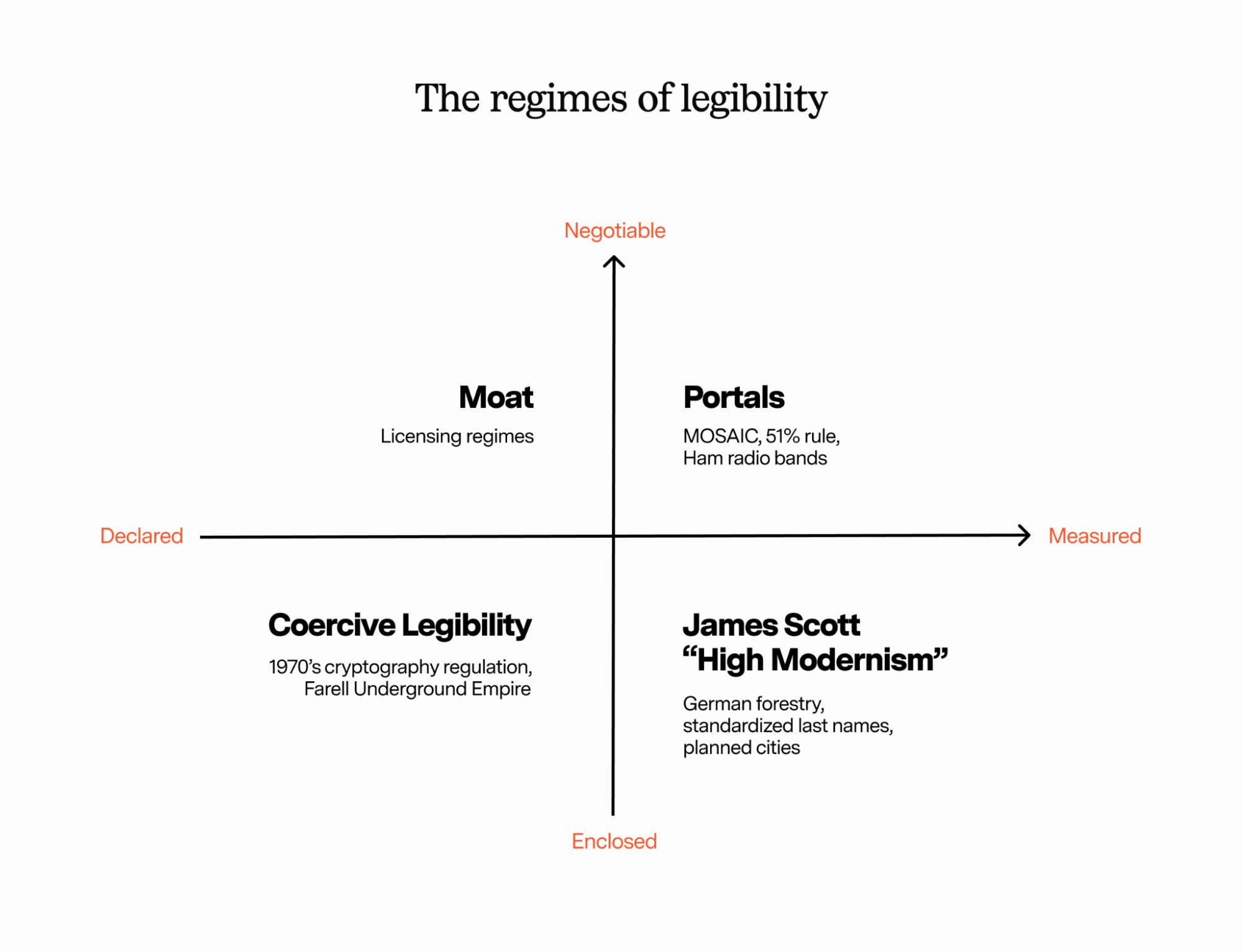
A negotiable category with a declared boundary becomes a moat, because insiders end up enclosing the field. Taxi medallions worked this way, and so does most occupational licensing. But this category is of less interest to us in this essay. A non-negotiable category with a declared boundary is coercive legibility, which spends itself down for the reasons Farrell describes. A non-negotiable category with a measured hard boundary gets used for the type of high modernist legibility that James Scott talks about. Export and import regulations are probably a good example of this.
In the upper right quadrant (always the best quadrant), a negotiable category with a measured boundary can . Experimenters play the role of ensuring that the boundary gets expanded or contracted. They are stewards to a portal, one which can either open the door to new creative possibilities or constrict into something that is enclosed.
This is the part that is easy to miss. The amateur bands were not valuable because operators stayed inside them. They were valuable because they became a sandbox for developing talent and running interesting experiments. Short waves crossing oceans went straight into the commercial and military world, and generations of engineers walked out of the hobby and into electronics. The experimental category was not valuable because homebuilders kept building homebuilts. It was valuable because there was a path out, from experimental to sport pilot to certified, and seventy years later a class of electric aircraft that nobody had imagined walked through it. A sandbox with no exit is a holding pen. A holding pen with tenure becomes a moat.
The present offers three different narratives for amateur technologists, each unsatisfying in its own way.
Cryptocurrency has run the cleanest narrative of the pattern and produced an ambiguous result. The cypherpunks won their fight, and encryption is now legal, cheap, universal and here to stay. Even if a large government wanted to get rid of it, that would be a hard and fruitless battle. But winning is not the same as building a portal. They defeated an enclosure rather than negotiating a category, so when Bitcoin and Ethereum arrived there was no measured boundary and no constituency the state already trusted. The state absorbed them on its own terms instead. Exchanges acquired licenses, ETFs got approved, and the ungovernable currency ended up with ticker symbols and compliance departments. If you told Zimmermann in 1993 that he could trade a federal criminal investigation for a spot ETF managed by BlackRock, I am not sure he would have been pleased.
Drones got a category and never got a portal. They inherited a partial bargain from the world the EAA built, but the recreational carve-out that emerged is narrow and largely declared. A hobbyist who gets good at building drones does not graduate into anything. There is no path from the amateur category into a commercial one, only a wall between them, which is a holding pen rather than a door. Meanwhile the American industry has been outcompeted by a Chinese one grown in exactly the kind of loose hobbyist soil the FAA distrusts. Perhaps MOSAIC and eVTOL development will eventually pull amateur drone operation into a wider frame.
AI sits in the fourth quadrant, and this is the uncomfortable one. Its boundaries are increasingly measured, since compute and capability thresholds are the closest thing we have to a 51 percent rule, but there are no insiders in the sense that matters. There is no amateur constituency with standing, and the regulatory conversation looks eerily close to the underground empire Farrell describes. Anthropic shipped Claude Mythos with safeguards already built in, and within days access was suspended entirely to comply with export controls, then restored three weeks later when those controls lifted. Dario Amodei has enthusiastically called for regulation of his own business, and is viewed with hostility and skepticism by the very bodies he wants to work with. That is what it looks like when there is no door and no one the regulator trusts standing at it.
Designing Portals
One of the papers I think about often is Charles Lindblom's The Science of Muddling Through. In 1959, Lindblom contrasted two modes of decision making. The root method was comprehensive and direct, evaluating the whole problem space and every option within it. The branch method, which he called successive limited comparison, builds out step by step in small degrees, according to what the situation currently demands. The root method is usually presented as the serious way to make a plan, but Lindblom argued it is rarely usable for complex policy questions, so administrators end up muddling whether they admit it or not. He preferred muddling, and his test of a good policy was disarmingly modest. A policy is good when the analysts find themselves directly agreeing on a course of action, without their agreeing that it is the most appropriate means to an agreed objective.
John Kay thought Lindblom was being self-deprecating to the point of being misleading, so he wrote a book called Obliquity to make the case properly. One of his central case studies in Boeing. Here’s the excerpt in full because it really gets to the heart of the idea:
“Bill Allen was chief executive from 1945 to 1968. Under Allen, the corporate purpose was to “eat, breathe, and sleep the world of aeronautics.”
During Allen’s tenure Boeing developed the 737. With almost four thousand planes in the air, it is the most successful passenger airliner in history. But the company’s largest and riskiest project was the development of the 747 jumbo jet. When a nonexecutive director asked for details of the expected return on investment, he was brushed off. Some studies had been made, he was told, but the manager concerned couldn’t remember the result. By the early 1990s Boeing had established almost complete dominance of world civil aviation. Boeing created the most commercially successful aircraft company, not through love of profit but through love of planes. The oblique approach to profitability delivered spectacular results.
Yet it took only ten years for Boeing to prove me wrong in asserting that its market position in civil aviation was impregnable. A decisive shift in corporate culture followed the acquisition of the company’s chief U.S. rival, McDonnell Douglas. The new CEO, Phil Condit, explained that the company’s previous preoccupation with meeting “technological challenges of supreme magnitude” would have to change. Directness would displace obliquity: “We are going into a value based environment where unit cost, return on investment, shareholder return are the measures by which you’ll be judged. That’s a big shift.” The company put the location of its corporate headquarters up for auction, and its senior executives agreed to move from Seattle, where the main production facilities were located, to Chicago. The newly focused business reviewed risky investments in new civil projects with much greater skepticism and made a strategic decision to redirect resources toward projects for the U.S. military that involved low financial risk. Chicago had the advantage of being nearer to Washington, where government funds were dispensed.
So Boeing’s civil order book fell behind that of Airbus, the European consortium. The aims of Airbus were not initially commercial but, by oblique chance, Europe’s champion became a profitable business. Boeing’s strategy of getting close to the Pentagon proved counterproductive. The company got rather too close and faced allegations of corruption. And what was the market’s verdict on the company’s performance in terms of unit cost, return on investment and shareholder return? Boeing stock, thirty-two dollars when Condit took over, rose to fifty-nine dollars as he affirmed the commitment to shareholder value; by the time of his forced resignation in December 2003 it had fallen to thirty-four dollars.”
Boeing’s troubles, as we all know, did not end there and continues to this day.
You might be thinking that the success of muddling through undermines legibility, and that is not wrong. High modernist legibility, such as the attempt to put export controls on cryptography, does end up failing and creating fallout. But strategic legibility, done well, looks like someone approaching a problem obliquely, according to the demands of the situation rather than a high modernist plan. When the spectrum was divided, it was answering the immediate problem of an unusable band, not designing a future for television. When the CAA wrote the experimental category, it was answering the problem of veterans building planes in garages, not designing a runway for eVTOLs. In both cases the answer was small, measured, and negotiated with the people it governed, and in both cases it turned out to have a portal to the future.
Perhaps the honest reading of these examples is not that strategic legibility always wins, but that it wins under conditions that are hard to recreate. You need a physical substrate, cheap experimentation, and a constituency large enough to negotiate with. You need a state willing to muddle rather than reach for the direct and banal answer. When those conditions are absent, legibility shapes itself into an enclosure.
So the question for anyone building something new is not whether you can remain illegible forever. That's neither productive nor possible. The question is can you anticipate what shape legibility will eventually take. Ask what new possibilities become available with legibility. If the answer is nothing, you do not have a portal. You have a room with your name on the door, and the rent goes up every year.