
If you work in tech and control some budget, you've probably been cold called. It was probably bad. You picked up (for some reason) and someone launched into a predetermined script about a product you've never heard of solving a problem you don't have.
This is the version of cold calling most founders have experienced, so it is not surprising that many of them have written off the channel entirely. Especially for technical founders, the phone can feel dated, low-status, or incompatible with modern GTM. But the problem is not that cold calling is a priori dead, the problem is that most cold calling is bad.
Pretty much every sales team in tech is cold calling. Even beloved developer brands like Vercel and Hex are hitting the phones. But for most of these teams it isn’t working very well. They treat it like a volume game: the playbook is to hire a bunch of recent grads, hand them a script and a phone, give them a few days of training, and tell them to dial 200 numbers a day. Like baby turtles frantically scurrying across the beach towards the ocean, a few of these precious BDRs will make it while the others are doomed to sniping birds from above (BDR managers and layoffs).
Then there is Temporal, who is doing things very differently. Their unusual approach to cold calling has allowed their BDR team to source almost 40% of their entire new pipeline this quarter from cold calls alone. They are converting 40-45% of the people who pick up the phone into meetings, well above the industry average.
Based on conversations with Matt Jones, who leads Temporal's BDR org, I’m going to go behind the scenes of how this team actually works:
- Why most cold calling programs are broken by design
- The "why you, why you now" framework that drives every call
- How Temporal trains BDRs for 60 sessions before they ever go live
- What happens when you treat BDRs like cultivable talent
The bigger lesson here is not just that Temporal is unusually good at cold calling. It is that founders may be underusing one of the highest-signal GTM channels available to them because they misunderstand what good cold calling actually is. Done well, a cold call is not a brute-force interruption, it is a fast way to test whether a specific person recognizes a specific problem at a specific moment.
A brief lay of the land on cold calling today
One thing that surprises people is that cold calling isn't just some relic of the pre-internet era. Every major enterprise software company – and increasingly, smaller startups post Series A – has a team doing this. Even the most hyped, developer-friendly, technical brands almost certainly have a team dialing executives right now.
The problem is how these teams are built and run.
At most companies, the BDR (business development representative) experience looks something like this:
- You graduate from college (nice).
- You get hired into a "sales development" role.
- You sit through a week of training that covers the product at a surface level.
- You're handed a list and a dialer.
Your job is to make as many calls as possible, always >100 and in many cases >200 per day. The tools to make these calls have gotten more sophisticated, as there are platforms now that let you dial five people simultaneously and connect you to whoever picks up first. But despite the “advances” in technology the philosophy hasn't changed. It is a numbers game.

Imagine if Jordan Belfort could have called 5 people at once.
The scripts for these calls are very generic. The same product pitch goes to a CTO as goes to an engineering manager, the same message for financial services as for e-commerce. There's no training on what different industries actually care about, no understanding of the personas being called, and certainly no research on the individual human being whose phone is about to ring.
The connect rate on cold calls — meaning the percentage of dials where someone actually answers — is somewhere between 5 and 7%. That number has been remarkably stable for years, which is interesting given the new features on phones that are supposed to filter these out. But still today, out of every 100 calls, you're getting five to seven conversations. And at most companies, the conversion rate from those conversations to actual meetings hovers around 20-30%.
This math works if you dial enough, but it poisons the pond! Every bad cold call makes the next one harder for everyone. Perhaps most importantly, the BDRs themselves burn out fast, because spending eight hours a day reading scripts to people who hate hearing from you is, unsurprisingly, miserable. You get off the phone feeling like you bothered someone, when what you really want is to feel like you gave them useful new information, brought them some value.

A typical conversation between a manager and BDR.
Matt Jones, the Temporal team, and a different approach
Matt Jones has spent his career in BDR organizations. He started at a wholesale telecommunications company where, every morning, there was a pamphlet on his desk with 200 names and phone numbers. He had a script from three days of training. His job was to start at the top and work his way down.
He went on to Mulesoft, where things were different. Mulesoft flew new hires to San Francisco for a full month of what amounted to grad school for sales development — classroom training from 8 to 5, then self-study until 10 or 11 at night, 30 days straight, before anyone made a single call. At Snowflake, the training program ran three months. These places might not have been perfect, but they were investing in this program in a real way.
Today Matt’s team at Temporal is 20 BDRs (soon to be 22), with plans to reach around 50 next year. They’ve scaled up quickly because what they’re doing is working in a big way. Here are the basic ideas.
.png)
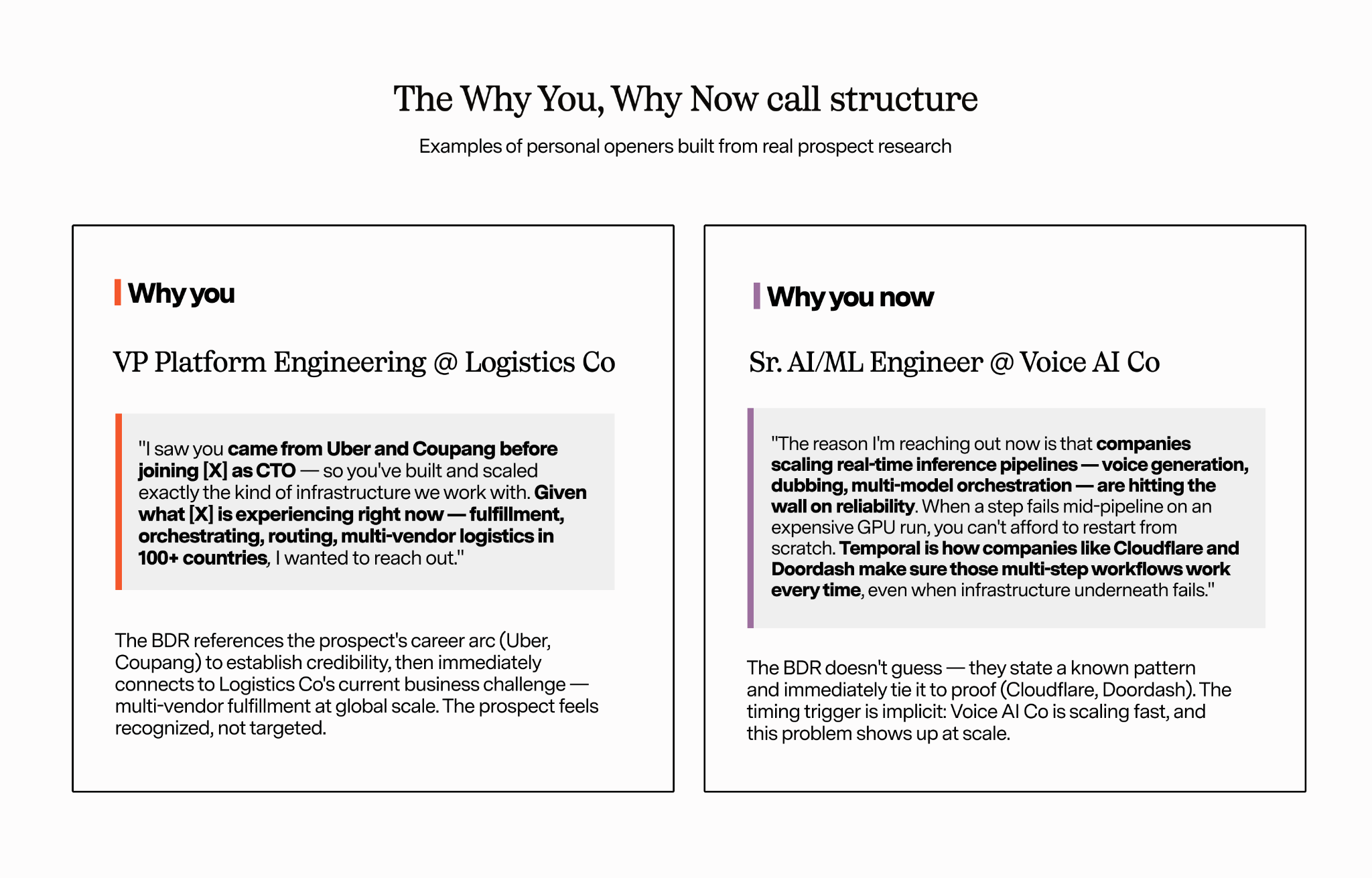
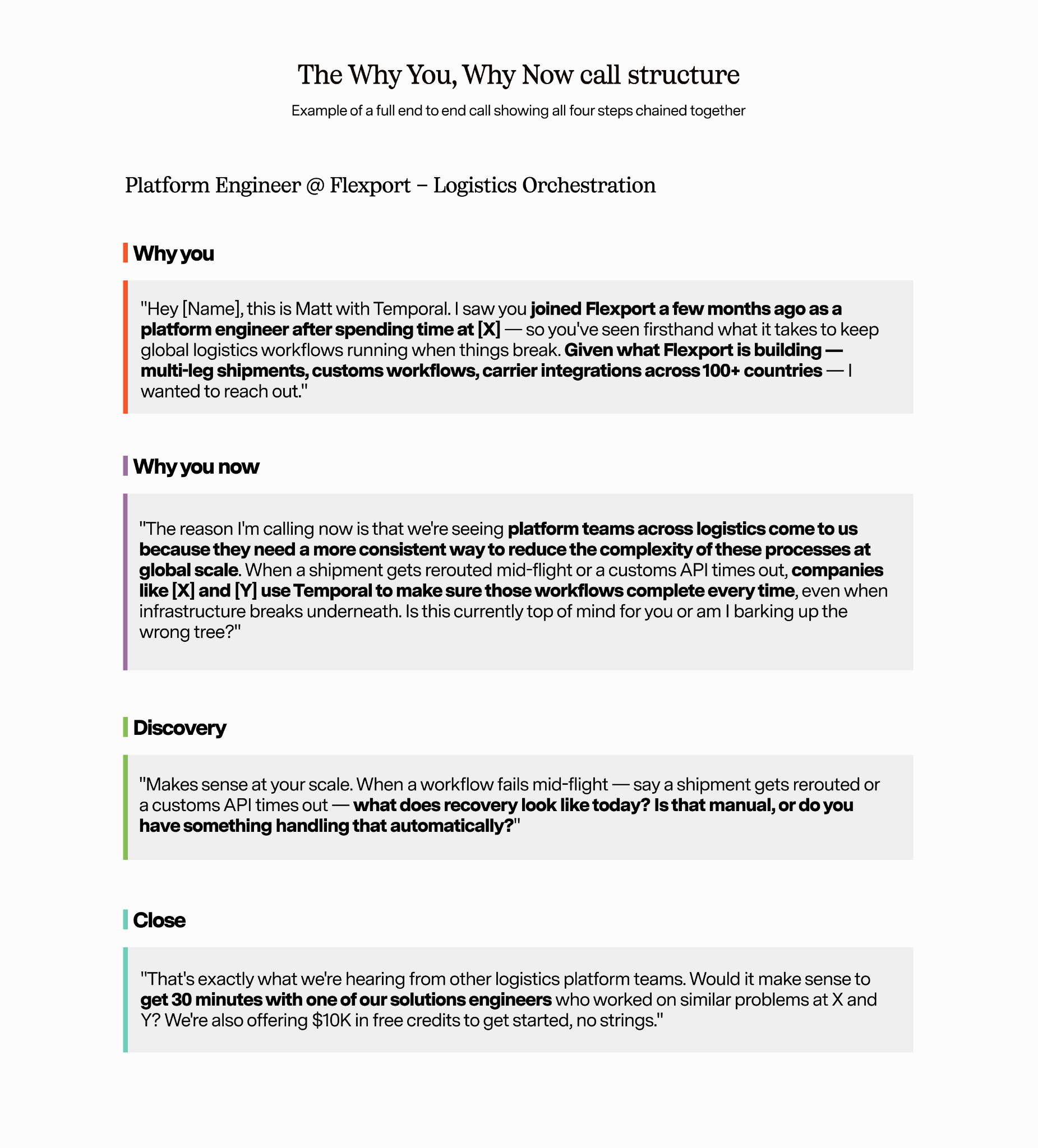
1) "Why You, Why You Now"
Before a Temporal BDR dials a single number, they have to be able to answer two questions about the specific person they're calling: why does this person care about what Temporal does? And why should they care right now?
This is the antidote to generic scripts. The goal is to address not why a generic prospect might care, but instead why this person, and why today.
Okay, duh, personalization = better. But the infrastructure to make it work is non-trivial. Temporal has built out "why you, why you now" documentation for every industry they sell into — financial services, logistics, e-commerce, retail, healthcare, tech — and within each industry, for every persona: developers, architects, platform engineers, engineering managers, SREs, CTOs. A BDR calling a platform engineering lead at an airline has a fundamentally different conversation than one calling a CTO at a fintech company, and the preparation reflects that.
These docs are also the floor, not the ceiling. Temporal BDRs further personalize (literally), pulling up the prospect's LinkedIn profile to find something specific — a recommendation someone wrote for them, a project they mentioned, a career transition, a conference talk. Something that signals this is a person who researched me, not a robot reading a list. This is not rocket science but it’s a touch that most BDRs just don’t add because of the volume>quality philosophy of so many organizations.
Lest you think that quality means more time on calls, the opposite is actually true. By the time a BDR at Temporal goes live, they should be able to build a personalized opening in 20 seconds. The training starts with a two-minute timer and compresses over weeks: 90 seconds, then 60, then 20. Speed and specificity at the same time is the goal (which is hard). A good cold call at Temporal runs about two minutes.
One objection worth addressing upfront is that this playbook is not just for Series C companies with a 20-person BDR team and three data vendors on retainer. The core principles – research the person, earn the right to their time, know the problem you solve, and have a point of view on why it matters now – are applicable to even the earliest stages. A co-founder doing GTM with their first sellers at a Series A company does not need the full Temporal operating system. They need 20 minutes on LinkedIn, a narrow account thesis, and a reason to believe this person may care.
If anything, early-stage companies have an advantage here. A founder calling a CTO carries inherent credibility that a junior BDR never will. The problem is that most founders either avoid the phone entirely or treat it like a volume game when they finally pick it up. Both of which never work!
2) Hard Knocks for cold calling
Most BDR programs give new hires a week of training and throw them into the deep end. Temporal puts every new hire through 60 (!) structured sessions before they ever go live on the phones.
During training, each BDR spends 8 to 10 hours per week on cold call practice alone. They do one-on-one role plays with Matt or their direct manager, small group sessions within their training cohort, and repeated reps of the "why you" exercise with LinkedIn profiles and timers.
Beyond the mechanics of calling, every BDR has to be certified on at least one customer story per industry, built around a challenger-style narrative arc. The standard Matt holds them to is something like…if I ran into you late at night and quizzed you on a Temporal customer in financial services, you should be able to walk through the entire story — who the company is, what challenges they were facing, how Temporal helped — without thinking about it. The stories have to be internalized to the point where pressure and nerves can't shake them loose.
And pressure and nerves indeed abound. Despite perceived brashness from the end for which the phone rings, it is not a natural thing to call F500 executives with aplomb. Matt has seen (and helped BDRs overcome) panic attacks from nervousness. There is only one way to get good at this and that is doing it over, and over, and over again.
Founders and early stage sellers do not need 60 structured sessions before calling their first prospect. But they should practice the opening, know the customer story they are going to reference, and be able to explain the pain without rambling.
3) A strong foundation of data
Personalized calling at scale requires good data. Bad data actively damages relationships. Early in Matt’s career a data vendor returned the wrong number for a prospect and instead of reaching the CIO of a top 5 bank, the rep accidentally called the CIO's wife. It didn’t go very well. This is the kind of thing that permanently burns an account.
Temporal runs a few data providers in parallel like Lusha, and ZoomInfo. For any given prospect, they have three independent chances to find a verified cell phone number and a verified email address. The redundancy is expensive but necessary when you’re doing high touch and low volume.
This is one of a BDR manager’s persistent coaching battles. BDRs, especially early on, will call the first number in the system. If it's dead, they mark the step complete in their sequence and move on — often relieved, because of the anxiety factor. But this is a waste, because you already did the hard work of researching the prospect, building your "why you," and getting them into a cadence. Go call the other numbers! LeadIQ might have missed it, but Lusha has three more options. The research is the expensive part, the extra dials are cheap.
4) Intentionality Over Volume
Most BDR orgs are volume shops. Temporal is an intentionality shop.
Matt’s team makes between 25 and 50 calls a day. At a company running a power dialer, that number might be 200 or 300. But with a 40-50% conversion rate on connections, the math doesn't require volume. Ten conversations in a day means four meetings, and four meetings is a great day by any BDR standard.
The cadence with prospects reflects the same philosophy. Over a 10-day period, a Temporal prospect gets about three touches between email and phone, and over 30 days about 8. Compare that to aggressive outbound programs where prospects might get 20 touches in 10 days. The sequence starts with a custom, manually-researched email and two days later, a call. Every touch is personalized, nothing is automated spray-and-pray.
Relevant here too is that the BDR team doesn't operate in isolation. Temporal's account-based marketing team runs coordinated campaigns against these very same accounts like custom landing pages for tier-one targets, personalized messaging, and paid ads. Sellers love war analogies, and there’s a WW2 one here: wherein the Air Force carpets a German stronghold with bombs (or WW1 with artillery) before the ground troops mount a frontal assault. Similarly (somewhat) by the time the BDRs hit the phones, the prospect has already seen Temporal's name. A Fortune 50 target might have a custom landing page showing case studies from their specific industry, the exact challenges Temporal solved, and the business outcomes that resulted.
A longer term investment via Coach, Hire, Retain
“OK, so why doesn’t every team just do this?”
Because there’s a systemic industry problem with how BDRs are viewed and treated thematically. At most companies BDRs continue to be viewed as expendable low-cost labor, infantry to be thrown carelessly at no-man’s land in copious volume and scant strategic thought. There is a reason that most of these people don’t last more than 8 months at the typical company.
Matt's and Temporal’s approaches are the opposite of this. A mentor early in his career told him the BDR leader's job is three things: coach, hire, and retain. Not "hit your pipeline number" or "maximize activity metrics." If you treat your BDRs like actual people and nurture their career growth they will impress you.
Accordingly, if someone is on Matt's team longer than two years, that is a failure on his part. The entire program is designed as a pipeline for the commercial sales organization: to train them, develop them, and then promote them. The BDR role isn't purgatory, it's a two-year accelerator for people who will eventually be pulling in $500K+ W-2s. Ideally at Temporal, of course.
This is, in a way, the part of the system that's hardest to replicate. It requires a leader who sees a 21-year-old and thinks about where they'll be in 10 years. Most BDR managers are measured on pipeline generated, and they manage accordingly via high volume, high churn, metrics-driven. Matt's team generates more pipeline with less volume because he invests in the people first.
So why doesn't everyone do this? Well, it's really hard. Building industry-specific and persona-specific enablement materials takes serious effort. Running 60 training sessions for every new hire is expensive. Maintaining three data providers costs real money. And the whole thing depends on having a leader who prioritizes coaching and development over raw activity numbers.
But Temporal's numbers suggest that the hard thing might be the right thing (who would have thought!). When your BDRs are trained deeply enough to have CTOs say "I'm so happy you called me today," you are onto something. If your founders think cold calling is beneath them, they might want to reconsider.